

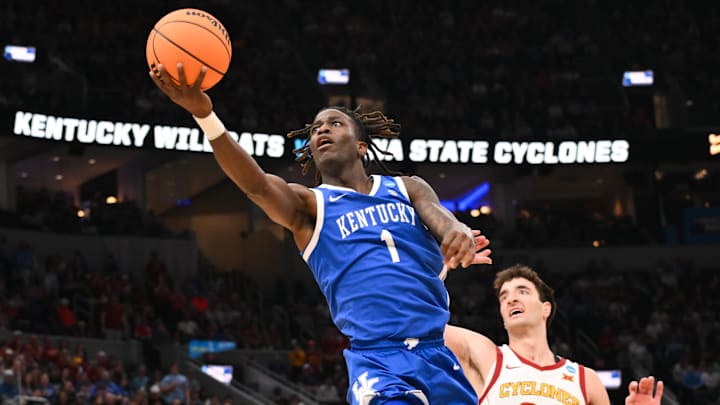
Basketball is a game of runs, but what happened to Kentucky against Iowa State wasn't just a momentum shift; it was a total structural collapse. And it happened in an embarrassing way.
In a suffocating Second Round NCAA Tournament exit, the Wildcats' season unraveled entirely in the margins. The most damning indictment of Kentucky’s roster construction this season isn't found in the final 19-point deficit; it is found in a brutal, four-minute window of game time.
When Denzel Aberdeen went to the bench, Kentucky was outscored by 15 points in just four minutes. A -15 plus/minus in that short of a span in a tournament game is practically a death sentence. It also shines a massive spotlight on a roster that simply wasn't built to survive at the highest level.
The glaring lack of a true point guard
When a team completely falls apart the second one player sits down, it usually means that player is a generational superstar. But in Kentucky's case, it meant that player was the only person on the roster capable of playing point guard, and he wasn't even supposed to be that guy.
Following the loss, head coach Mark Pope spoke with Tom Leach on the post-game radio broadcast and essentially admitted the glaring flaw in the backcourt design.
"I love him. DA ended up in a position that he wasn’t [supposed to be in]," Pope explained. "He was going to be a 'go get a bucket' two-guard, and he had to be a high-IQ, control-everything-on-the-floor [point guard]."
Aberdeen was recruited to score. He is a natural wing who thrives on getting downhill and hunting his own shot. Instead, due to an egregious lack of depth and foresight in roster building, he was forced to be the primary facilitator in the SEC.
Aberdeen deserves a massive amount of credit. As Pope noted, "He got us to the second round of the NCAA Tournament. He didn’t have a ton of support behind him." Aberdeen absorbed the pressure of a defensive juggernaut like Iowa State, sacrificing his natural playstyle to plug a massive, sinking hole in the ship like he did all year. He wasn't even that good today, he had 4 turnovers. But he was better than anyone else the Cats had.
And that is on Mark Pope.
A championship-caliber program cannot enter March relying on a two-guard playing wildly out of position to be its sole savior against elite defensive pressure.
When Aberdeen sat, the Wildcats had zero answers. The ball stuck, the offense stalled, and Iowa State's elite backcourt defenders relentlessly sped up anyone else who tried to bring the ball across half-court. That catastrophic -15 run in four minutes wasn't just a stroke of bad luck; it was the inevitable mathematical result of a roster that lacked a true backup floor general once Lowe went down.
You cannot scheme your way around a missing point guard against a team like Iowa State. The Cyclones exposed exactly what Big Blue Nation feared all season: the roster construction, at its core, just wasn't good enough to make a run.
And so they didn't.
 Add us as a preferred source on Google