

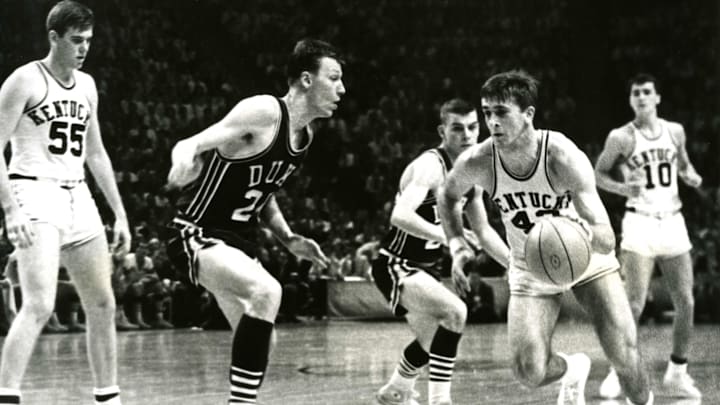
Kentucky basketball has a legacy that is nearly unmatched in the college world: championships, players, coaches, and a fanbase that is unique in the sports world. When you think of college basketball, the Kentucky logo comes to mind. So it is always nice when the present iteration of the Wildcats takes time to praise those who came before them and paved the way. That will happen Saturday as Pope and company will honor Pat Riley and "Rupp's Runts."
For those who have asked, yes, former UK All American Pat Riley is expected to be at Rupp Arena Saturday with other living members of 1966 Rupp Runts. Larry Conley is the only living member of that club who won’t be able to make it because of health reasons. He lives in Atlanta. pic.twitter.com/bTWDUnuGDj
— Oscar Combs (@wildcatnews) January 6, 2026
1966 was special in many ways for Kentucky and college basketball
The country was in the middle of desegregation. There were riots and fights across campuses in the South. Things were changing fast, but some in the South were holding on to the old ways with a tight grip.
To understand the world Rupp’s Runts were playing in, you have to look at the cultural landscape. The Civil Rights Act had been passed just two years prior, and the Voting Rights Act just the year before. The SEC was not just a sports conference; it was a place where segregation was handled with a "Gentleman's agreement." No one said it out loud, but none of the schools in the South would play black players, nor would they play against them when they went to the North.
Rewind to just ten years before the 1966 season, the political pressure to keep sports segregated was so intense that the Governor of Georgia, Marvin Griffin, publicly threatened to bar Georgia Tech from playing in the Sugar Bowl simply because their opponent, Pittsburgh, had a black player. The Governor declared that "The South stands at Armageddon" and argued that playing an integrated team would destroy the integrity of the South. Riots broke out on Tech’s campus just to fight for the right to play a football game.
That was the environment SEC coaches lived in. Administrators and politicians held the keys, and they were terrified of the optics of integration. They held most, if not all, the power in what could and could not happen.
Adolph Rupp isn't the man most people think of. The movie Glory Road did him a disservice, and if you saw that film and base your idea of what he thought on it, you would be surprised to learn the actual truth.
The truth was, Rupp, like many, wanted to desegregate. He wanted to recruit black players to Kentucky, but he faced immense pressure from those around him and in power at the time not to do so.
According to research by people like Dick Gabriel, the narrative that Rupp was a staunch segregationist falls apart when you look at the details.
- Rupp actively recruited stars like Wes Unseld and Butch Beard. He and his assistant, Neil Reed, watched Unseld play 13 times. Beard actually verbally committed to UK before flipping to Louisville on signing day. This was before Tom Payne committed to Kentucky in 1969.
- In the early 60s, UK President Dr. Frank Dickey polled the SEC about ending the "gentlemen's agreement" banning black athletes. It was overwhelmingly voted down. Rupp even asked to leave the SEC, so he could recruit freely, but was denied by the UK Board because they didn't think they could sell tickets.
- Rupp and his staff received hundreds of death threats for recruiting black players, many of which were turned over to the FBI. He feared for the safety of any black player he brought in, knowing the abuse they would face in opposing SEC arenas.
Rupp didn't want a "token" player just to satisfy a quota; he wanted a Jackie Robinson-type star who could handle the abuse and help Kentucky win. He simply ran out of time before the world finally caught up. This isn't something to just write off, and to those who just say Rupp was a racist, this should at least paint a broader picture of what was really happening.
The 1966 Kentucky basketball team: Small in stature, huge in heart
That is why bringing the 1966 team back to Kentucky matters for a fanbase that loves its history. It isn't just about the politics of the era; it is about a basketball team that defied the odds and did something few thought possible.
They were nicknamed "Rupp's Runts," and it was not in jest. Back in the 60's, there were no dominant 7'0 players on each team, but there was still height. Not at Kentucky, no starter on this Kentucky team was taller than 6'5". Their center, Thad Jaracz, was listed at 6'5", and he was battling guys half a foot taller than him, if not more.
Despite the size disadvantage, they were a juggernaut. They finished the season 27-2. They were led by Pat Riley (6'4"), Louie Dampier (6'0"), Larry Conley (6'3"), and Tommy Kron (6'5").
They played a beautiful style of basketball. They were fast, efficient, and tenacious at every position. They made it all the way to the National Championship game, a game that lives on for many reasons.
The Cats would lose that title game to Texas Western, a game that became a historical landmark in the country. The Miners were the first major college team to start five black players in an NCAA Final. They then won it all, and Rupp's Runts were seen as the last bastion of the old ways, though they were far from it.
This Saturday, as the 1966 team steps onto the floor to be honored while the current Cats play the Bulldogs, let’s not just portray the past with a narrow view. Let’s honor a group of guys who played their hearts out, and a coach who was far more complex than the movies would have you believe.
 Add us as a preferred source on Google