

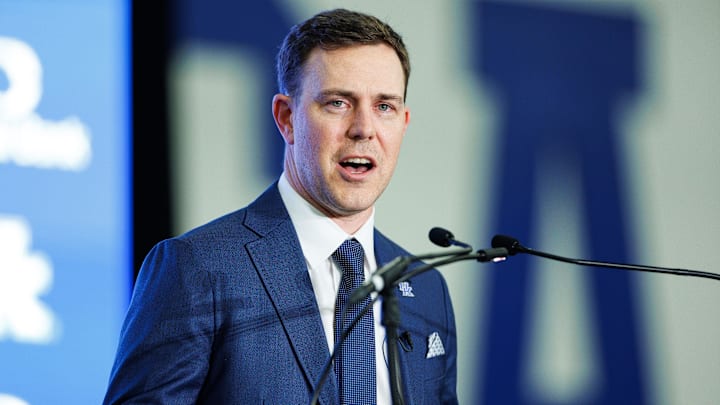
Will Stein could have gone a lot of places. He chose Lexington. Sure, he played quarterback at Louisville and grew up in the state, but that’s not the only reason the former Oregon offensive coordinator left Eugene to replace Mark Stoops. The more important reason is that he thinks Lexington is a place he can win.
Stein established himself as one of the most diverse gameplanners and best play-callers in the country during his three-year stint with the Ducks. Now, at 36 years old, he’s a first-time head coach with big aspirations for a program that has had three 10-win seasons since Bear Bryant left in 1953. But after what he saw firsthand in the Big Ten, those dreams may not be rooted in naivete.
“Indiana, they were always bad,” Stein told The Locker Room on 680 The Fan in Atlanta. “I never would’ve left Oregon if I didn’t feel I could win.”
It’s not easy to be Indiana
Indiana football winning the national championship in Curt Cignetti’s second year leading the program is the most impressive turnaround in the history of sports. It should give hope to traditional bottom feeders because it’s proof that a turnaround is possible, but coaches of those programs, like Stein, should proceed with some caution when attempting to emulate Cignetti’s success.
Seemingly every time a program wins a championship now, the narrative emerges that they bought it, and while that’s always disingenuous, it is true that Indiana got a massive financial investment in its football program, and in the NIL era, that makes a huge difference. In some ways, with billionaire alumni like Mark Cuban and the largest living alumni base in the country, the Hoosiers were a sleeping giant.
Kentucky ponied up to pay Stoops’s considerable buyout, and after spending three years with the Phil Knight-backed Ducks, Stein knows what it takes financially to compete at the highest level in college football. If he wasn’t happy with Kentucky’s level of investment, he probably wouldn’t have taken the job. Still, is Kentucky football spending on Indiana’s level? Probably not.
Next, there’s the NFL quarterback factor. Indiana raised its talent level dramatically over two years by leaning heavily on the transfer portal. Some of that was done with the James Madison players who followed Cignetti to Bloomington, a luxury that Stein, as a first-time head coach, didn’t have.
However, probably the biggest reason Indiana vaulted itself to championship caliber was its quarterback. Fernando Mendoza was a high-upside addition when he arrived from Cal, choosing Indiana over Georgia and others in the mix, but few expected him to immediately become a Heisman Trophy winner and first overall pick in the 2026 draft.
That’s not to say Indiana’s model isn’t sustainable, because doubting Cignetti at this point would be a fool’s errand. It’s to say that the speed with which the turnaround happened and the heights that were reached, likely wouldn’t have been possible with even just a very good quarterback, instead of the Heisman Trophy winner.
Will Stein’s confidence is what Kentucky needs
With that all being said, Stein is taking the right approach. He’s setting the bar high and expecting to compete in the SEC. That may not be exactly the message to boosters behind closed doors, but like Cignetti, Stein isn’t pulling any punches, and that’s a great way to engage the donor base. Like it or not, even with the ability to pay players directly through the revenue-sharing cap, coaches have to be fundraisers, and Stein is doing a great job of that so far.
Ultimately, though, it will come down to the product on the field because if it looks like more of the same in Year 1, that enthusiasm will fizzle out by the time basketball season starts. You won't find anyone who disagrees with him, but in comparing the program he inherited to Indiana, he called Kentucky bad. That's blunt, and that's bold, but right now, it's probably the right message to send.
 Add us as a preferred source on Google