

There are games you win, and then there are games that win you.
On New Year's Eve 1977, #1-ranked Kentucky walked into Freedom Hall carrying the weight of perfection—7-0, unblemished, promising. But promise is unproven currency. The #4 Notre Dame Fighting Irish arrived in Louisville fresh off stunning UCLA at Pauley Pavilion. Everyone in college basketball knew what Digger Phelps's teams did to top-ranked opponents in the 1970s: they embarrassed them.
What happened over the next two hours accomplished more than preserving an undefeated record. It marked the precise moment a talented roster hardened into a championship machine.
The shadow that wouldn't lift away from Lexington
Twenty-eight days earlier, Adolph Rupp had died.
Joe B. Hall didn't need the reminder. For six seasons, he’d coached in Rupp’s colossal shadow— just one Final Four, zero national championships. The Kentucky faithful had grown restless. Excellence wasn't enough; they demanded dominance.
"It's very seldom that a team starts out on top and goes all the way," Hall admitted before the season. The doubt in his voice was audible.
But this team felt different. Senior forward Jack "Goose" Givens was smooth as silk, a mid-range assassin whose jumpers barely rippled the net. Senior center Rick Robey had transformed his body through obsessive weight training—shaving four inches off his waist and adding four inches to his vertical leap.

And then there was Kyle Macy.
Macy was the catalyst. A transfer from Purdue who’d sat out the entire 1976-77 season, he was forced to watch while NCAA transfer rules kept him caged. He’d left Purdue because he felt the program didn't prioritize the collective unit. To Macy, the scoreboard mattered infinitely more than the box score.
Notre Dame’s scouting report dismissed him as average on defense, a secondary threat. They were about to learn a painful lesson in underestimation.
A neutral court in Louisville that wasn't
Freedom Hall could hold 16,869 people. On December 30th, the day before the game, 9,000 Kentucky fans showed up just to watch their team practice. Open practice. No game, just drills and layup lines and the chance to breathe the same air as their Wildcats.
When Notre Dame took the court afterward, 80 people remained.
During the chaos of Kentucky's practice, one zealous fan snipped a lock of Rick Robey's hair. Not as a prank but as a keepsake. This was devotion bordering on madness, a level of fanaticism that terrified visiting teams.
Digger Phelps knew the environment was hostile. "Down here they have everything in their favor," he complained. He’d brought a six-piece student band to generate some Irish spirit. They knew one song: the Notre Dame Victory March. When game time arrived and the band launched into their anthem, the sound was thin, swallowed whole by 16,400 pompon-shaking fanatics drowning the arena in blue.
Phelps had once called this annual matchup "the Rose Bowl of college basketball." On this New Year's Eve afternoon, with the tip scheduled for 4:00 PM so players could still get their midnight kiss, it carried the intensity of a national semi-final, arriving three months ahead of schedule.
When dominance turned to doubt
For 30 minutes, Kentucky operated as the undeniable #1 team in America.
Givens scorched Notre Dame for 16 first-half points. Robey threw down a thunderous dunk off a full-court pass from Macy that sent Freedom Hall into delirium. The Irish managed just 8 points in the first 10 minutes—all from Bill Hanzlik—and trailed 42-34 at halftime. Kentucky’s defense was suffocating. Notre Dame looked lost.
And then, slowly, the Irish found their footing.
Kelly Tripucka, a freshman off the bench, sparked a second-half rally with 15 points. Rich Branning hit key jumpers. Duck Williams scored back-to-back baskets. Notre Dame, a team that specialized in toppling giants, clawed back possession by possession until the impossible became real.
With less than four minutes remaining, Notre Dame took a three-point lead.
Freedom Hall, which had roared for two hours, fell silent. You could feel the fear spreading through the crowd like a chill. Kentucky had controlled the game by double digits. Now they trailed. Now the moment had arrived: that fragile instance when elite teams often fold, when the pressure of the ranking becomes unbearable.
Kentucky reserve Jay Shidler picked up a technical foul arguing a call on Tripucka. Frustration set in. The undefeated season began to slip away.
That’s when Kyle Macy decided he’d seen enough.
Eight points, four minutes, one legacy
What Macy did next wasn't flashy. It was surgical.
First, a 22-foot jumper. Calm. Controlled. Nothing but net.
Then came the sequence that defined the game: a twisting baseline layup, threading between defenders, contorting his body mid-flight to kiss the ball off the glass. Kentucky reclaimed the lead. For good.
Macy wasn't done. Another jumper, this one from 12 feet. Then two free throws to ice it.
Eight straight points. In four minutes. With the season on the line.
Final score: Kentucky 73, Notre Dame 68.
NBC named Macy the game’s MVP. He finished with 18 points and 5 assists, but the stats fail to capture the command he displayed. He pressured Rich Branning into three turnovers, including two five-second violations. He ran the offense with the poise of a veteran, not a sophomore making his first national statement.
After the game, Notre Dame assistant coach Danny Nee looked shell-shocked. "I completely blew the scouting report on him," he admitted. "I didn't think he was nearly this good".
Scouting reports can measure athleticism. They cannot measure a player’s refusal to lose.
What Kentucky didn't know they'd proven
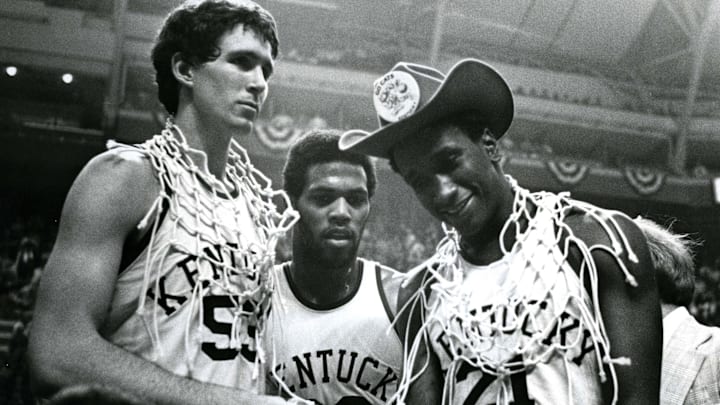
In the moment, this was just a December win. Kentucky improved to 8-0. Notre Dame fell to 7-2. Both teams would eventually reach the Final Four. Kentucky would finish 30-2 and cut down the nets in St. Louis three months later, with Givens scoring 41 points in the championship game against Duke.
But that title game would not have felt inevitable without this night.
This was the crucible where Kentucky learned to close. They discovered that when the moment tightened, when the crowd noise faded and the scoreboard turned hostile, they possessed a leader who wouldn't blink. Kyle Macy, the transfer who’d been doubted, took the game by the throat when it mattered most.
Joe B. Hall would finally step out of Rupp’s shadow. Givens would become a legend. Robey would anchor a championship frontcourt. But the identity of that team was forged here, on New Year’s Eve, in a game that teetered on the brink of collapse.
Instead, it became the night Kentucky stopped asking if they were good enough and started proving they were inevitable.
The echo that never fades from BBN's mind
Forty-seven years later, Kentucky fans still measure their teams against that feeling. Not the championship—the moment before it. The game that revealed who they really were. December games matter because championship teams don't wait until March to show themselves. They emerge early, quietly, in the kind of game where momentum swings and the crowd holds its breath.
Today's Kentucky teams face the same scrutiny. Do they possess greatness? Have they been truly tested? The 2025-26 Wildcats entered the season with high expectations, only to stumble through early struggles that had Big Blue Nation questioning everything. It serves as a reminder that promise does not equal proof.
And let’s be honest: that kind of proof is harder to find these days. Remember, Macy sat out a full year to wear Kentucky Blue. He didn't jump into a portal because he wanted more shots or a better NIL deal; he waited, he practiced, and he earned it. Macy didn't view his year on the sidelines as penalty; he viewed it as a down payment.
December remains the testing ground. New Year's Eve is still when you find out who you are.
And somewhere, in the memory of everyone who was there that night in Freedom Hall, Kyle Macy is still spinning baseline, still rising, still refusing to let go of what matters most.
Kentucky fans don't just remember that shot. They measure every team since by whether it has someone willing to take it.
More Kentucky basketball history that still shapes today
- Should Kentucky fans really exhale right now?
- Ranking the greatest seasons in Kentucky basketball history
- When Kentucky last won an NCAA Tournament championship
- Kentucky’s Sweet 16 history and what it says about expectations
- Is Kentucky actually a Top 25 team right now?
 Add us as a preferred source on Google