

If you want the short version of how to fix college sports, you have to start by admitting the obvious: Stop pretending this is still amateur sports.
That isn’t a hot take anymore. It is a reality check. And the clearest proof that the old world is gone arrived this week in Waco, Texas.
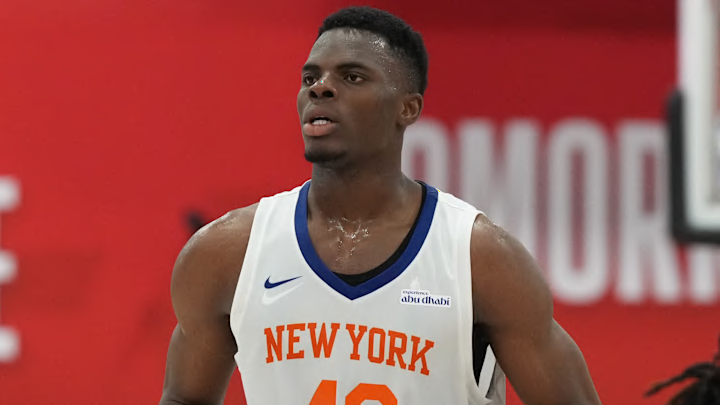
James Nnaji, a former NBA draft pick with professional experience, enrolled at Baylor and is expected to be immediately eligible to play college basketball. A few years ago, that sentence would have sounded insane, remember Enes Freedom? This is a player who was drafted by the NBA, played in the summer league, walking into a college classroom to play on a Tuesday night? It would have triggered a year-long investigation.
Now, it is just another headline in the Wild West. And it signals that the rulebook is no longer a rulebook, it’s a suggestion box held up by the NCAA who is begging to stay in power, but is actually powerless already.
College basketball is living in a loophole economy
When Name, Image, and Likeness (NIL) started, there was a naive hope that it would be clean. The pitch was simple: players land legitimate endorsements, build their personal brands, and schools stay out of the "pay-for-play" business.
That dream died almost immediately and has no shot of ever returning.
Instead of a regulated market, we got collectives functioning as shadow payrolls. Recruiting morphed into an open auction, and roster management became a game of constant churn where loyalty is determined by the highest bidder. The NCAA didn’t just "lose control" of this process; it handed the keys away because it refused to build a modern framework fast enough. Now, the organization is just a passenger, reacting to court decisions and public pressure while the sport speeds off a cliff.
Nnaji’s situation matters because it highlights the new standard. The only firm line left seems to be actually checking into an NBA game. Everything else, draft status, pro contracts overseas, G-League stints, is suddenly negotiable.
The collateral damage for Kentucky basketball no one mentions
The most dangerous part of this shift isn't that college basketball becomes "roster roulette" with former pros spinning the wheel. It’s who gets hurt when the bubble eventually bursts.
While football and men’s basketball drive the headlines and the revenue, the Olympic sports are quietly sitting in the blast radius. Kentucky volleyball just went to the national title game, the baseball and softball teams have recent World Series appearances, gymnastics is on the upswing, track and field has produced elite winners like Sydney McLaughlin-Levrone.
When revenue sports become more expensive, driven by NIL demands, legal costs, and the inevitable move toward revenue sharing, athletic departments start looking for cuts. And they rarely cut the programs that print money. They cut the swimming teams, the track squads, and the "redundant" programs that don't move the financial needle.
That is the nightmare scenario: the biggest sports get richer, the NCAA claims "growth," and the sports that actually feed Team USA pipelines get squeezed into oblivion because the budget went to a backup quarterback’s signing bonus.
It is not a matter of if, it is simply a matter of when.
The inevitable endgame no one wants, but everyone needs
The moment you admit the truth, that this is a labor market, you start moving toward the only logical conclusion: collective bargaining.
If athletes are effectively employees (and the courts are certainly leaning that way), then schools and conferences will be forced to build structures that look like professional sports. We are hurtling toward a world of contracts, standardized benefits, and injury protections.
The NCAA doesn't want that because it loses power. But the Nnaji situation proves that the NCAA has already lost the power. The toothpaste is out of the tube, and no amount of "amateurism" rhetoric is going to put it back in. The sport is professional now. It’s time to start governing it like one.
You don't have to like it, we certainly don't, but it just the way it is.
 Add us as a preferred source on Google