

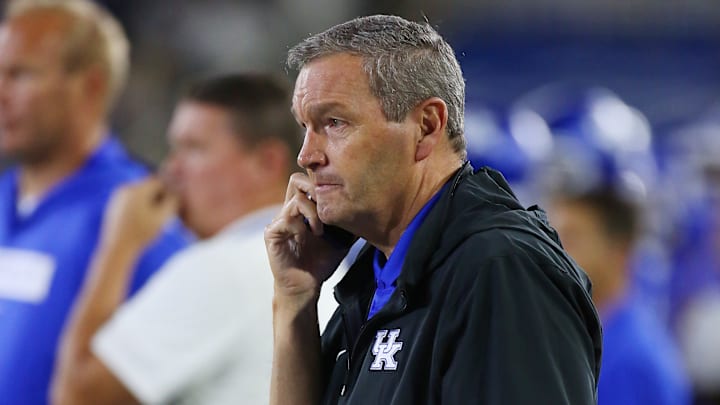
If you’re a Kentucky fan trying to make sense of NIL, revenue sharing and JMI, you’re not alone. The athletic director running the whole thing admits it’s “clunky” right now.
From losing ground with high school basketball recruits like Tyran Stokes and Christian Collins, BBN is at all-time high in recruiting anxiety.
In a long sit-down with the Lexington Herald-Leader, Mitch Barnhart tried to explain how Kentucky is operating in this new College Sports Commission / NILGo world. The message was basically this: yes, it’s confusing; no, Kentucky isn’t freelancing; and he believes the structure he’s put in place is actually a strength, not a handicap.
Convincing the fanbase of that isn't going to be easy without recruits showing up.
‘Clunky’ rules, moving caps and a promise to stay in the guardrails at Kentucky
Barnhart said the current landscape is really two different eras smashed together: what was done before July 1, and everything that’s been built since the House settlement, the College Sports Commission and NILGo went live.
Different schools had different pre-July 1 spending patterns. That history impacts how much cap space they have now. Some have more room. Some have less. That’s part of why it looks like schools are operating under different rulebooks.
Barnhart’s word for the rollout was “clunky.” There are participation agreements that not every school has signed yet, rules that have to go through courts and attorneys general, and separate 30-day windows for both the House plaintiffs and state AGs before some policies can even be implemented. Some rules are in effect. Others are still in line.
In the middle of all that, Barnhart keeps coming back to the same idea: Kentucky is trying to be “steady,” stay within the “guardrails,” and trust that “progress is being made” as the national framework catches up.
That might not satisfy fans who look around and see other schools clearly pushing those guardrails, but it’s the lane he’s chosen. Pope backed that up by saying they will always "err" on the side of caution when it comes to NIL.
NILGo, averages and a ‘hot market’ in Lexington
On the actual NIL payouts, Barnhart said all deals now flow through NILGo, and Kentucky has already had “several hundred” go through the system. At the Champions Blue meeting in October, he pegged the average deal around $3,000, with the biggest near $50,000. He said those numbers are still “trending in the same way.”
He pointed to Kentucky volleyball as a prime example of what a “hot market” looks like. A Final Four run has made that roster more visible in Lexington, and as their “notoriety” has grown, so has their NIL value. Barnhart sounded genuinely excited talking about watching those opportunities grow for non-revenue athletes.
For fans who worry Kentucky isn’t doing anything, that’s the counter: NIL deals are happening, they’re in seven figures across the department, and not just in football and men’s basketball.
The question, of course, is whether that level of activity is enough to land and keep the kind of top-end basketball talent BBN expects. So far, the answer to that question seems to be no.
Why Mitch Barnhart is all-in on JMI
A huge chunk of the interview was essentially a defense of the JMI model that fans hate.
Barnhart’s pitch goes like this: JMI arrives with more than 200 corporate partners already on board and a seasoned sales force generating $35–40 million a year in advertising and sponsorships. That group is now tasked with not just selling Kentucky athletics, but also matching student-athletes with those brands.
From his perspective, that’s an enormous head start. You’ve got a big, experienced sales staff already embedded on campus, already working with companies that “are very, very interested in your program,” and now they can turn that machine toward NIL.
He also made a key point that’s been blurry for fans: JMI isn’t skimming a cut off those NILGo deals. “There’s no fee,” Barnhart said. “We’re fee-free.”
So what’s the trade-off? Marks and flexibility.
If a student-athlete wants to use Kentucky logos and IP in their deals, that path runs through JMI. If they sign with a company that competes with an existing UK sponsor, Barnhart said they’re “certainly” encouraged to give Kentucky partners first crack, but athletes can still go ahead with outside deals they just can’t use the marks.
That is a huge deal. Being able to use the UK brand, and the notoriety that comes with Kentucky basketball is a huge draw for NIL-minded athletes. Not being able to use those can be a deal breaker.
He pointed to cases like Trent Noah, who has hometown relationships he wants to honor, and players who arrive with pre-existing high school NIL deals. The message there was, “We work through it,” even if it’s messy. Noah decided to not opt-in with JMI and has deals all through the commonwealth, you just won't see the UK logo anywhere.
The flip side is obvious: if you don’t like or trust JMI, you’re going to see this entire structure as restrictive, even if the AD keeps calling it a “really cool” family.
Barnhart speaks on conflicts of interest and long relationships
Barnhart didn’t dodge the question about perceived conflicts between UK staff and JMI personnel. He just doesn’t see a problem.
To him, the long-standing ties that span from the Jim Host era to IMG to now 11 years with JMI and a new extension through year 25, are a feature, not a bug. He framed it as a tight-knit group of people who love Kentucky and know the market, not as an insider network that needs to be broken up.
A lot of fan angst comes from the Rachel Newman Baker-Brandon Baker relationship. Rachel is an assistant AD at UK while Brandon is Vice President Partnerships at JMI with the title UK Sports & Campus Marketing. According to JMI, "Brandon’s role is focused on aligning key partners’ marketing objectives with the goals and vision of the university. He directs the team that oversees all key partnerships and renewal business, as well as gameday activations, partner hospitality, and stadium/arena signage."
“If it was a conflict,” Barnhart essentially argued, why have revenues and rights deals grown so aggressively?
That answer is unlikely to quiet any critics of the relationship between UK and JMI. Some fans hear “family” and “long-term relationships” and immediately think of a closed ecosystem that’s hard to challenge. But Barnhart is clearly not backing away from that model. If anything, he’s doubling down on it as a competitive advantage.
Why Barnhart won’t show his revenue-sharing cards at Kentucky
Maybe the most interesting part of the interview was his insistence on keeping revenue-sharing numbers private.
Barnhart pushed back on the idea that it’s about secrecy. He called it “flexibility.”
In his view, there are two separate buckets: revenue sharing and NIL. He thinks fans and some schools have blurred those lines by bragging about a big “NIL” number that’s really a mix of both.
He wants the freedom to slide resources between those buckets depending on the sport, the year and the player. Maybe a high-profile recruit is better served taking more in rev share and less in NIL, or vice versa. Maybe football needs a bigger push one offseason to address a critical position, while basketball doesn’t. Maybe in another year it’s the opposite.
If he puts hard public numbers on what each program gets, he worries he’ll lock himself into boxes that hurt Kentucky competitively and create a circus of fans comparing individual payouts.
He also says there’s a protective piece: he doesn’t want each athlete “pegged” publicly by a dollar figure or constantly compared to teammates.
You can debate whether that explanation is satisfying, or whether transparency would actually help calm the waters, but it’s at least a clear window into his thinking.
For fans it is just Mitch Barnhart saying they have the money, but won't show a receipt.
Balancing Kentucky football, Kentucky basketball and the rest of the athletics department
Kentucky’s situation is unusual. Both football and men’s basketball are profitable. Most schools can’t say that.
Barnhart admitted that balancing those two in this new world is tricky. Pre-July 1, he says everyone loved the rosters. Post-July 1, the math is just harder across the board, not only at Kentucky.
His bigger picture vision is to use the power of the Kentucky basketball brand to lift everything. If NIL and rev-share decisions are made wisely, he believes success in men’s hoops and football can raise the tide for baseball, women’s basketball, volleyball and everyone else.
That’s the optimistic version. The pessimistic version is what some fans are already feeling: if basketball misses on elite recruits and football falls behind the SEC arms race, nobody gets lifted and everything falls apart.
On general managers, Mark Pope and ‘talent evaluation’
Barnhart also weighed in on the “general manager” debate that’s hovered over Kentucky basketball.
Will Stein came in and immediately wanted a GM for football. Barnhart was fine with that. For a first-time head coach juggling a new staff, a playoff run and a roster rebuild, he called it “probably a pretty smart decision.”
With Mark Pope, he’s not forcing the issue. Barnhart said he’s going to “lean into” Pope’s preference and give him the flexibility to decide whether he wants that role or not down the line.
Then he slipped in a line that will jump out to fans: “Our talent assessment was fine until we lost a couple games, and then everybody started wondering about our talent assessment, correct?” Well, Mitch that is usually how it works.
In other words: he doesn’t think one rough stretch means the eval process is broken, and he doesn’t believe a GM is some magic fix. But he did leave the door open to adjustments later if Pope decides he wants to structure things differently.
Will Mitch Barnhart still be the one steering this or will he retire?
Finally, the obvious question: how much longer does he want to do this?
Barnhart acknowledged the ambassador clause in his contract that would allow him to step aside after December 31 and shift roles. He didn’t commit one way or the other.
He talked instead about loving competition, loving Kentucky and the fact that he and his family came planning to stay 6–8 years and never left. He admitted the job has changed, where it used to be 75% competition and 25% “other stuff,” he thinks those numbers have flipped. Now it’s more about sustaining the enterprise of college sports than just trying to win Saturday.
He also admitted the personal connection piece is harder in an era where 35–40% of the roster turns over every year. Meeting every recruit, knowing every family? That’s tougher now.
But the thrill of competition is still there for him. “The day that changes,” he said, is probably the day someone else should take over.
That’s the backdrop to everything he just laid out: a clunky system, a controversial partnership model, a fanbase demanding top-tier results, and an athletic director who insists Kentucky has “a good plan” for all of it, and says he still wants to be the one fighting to make it work.