

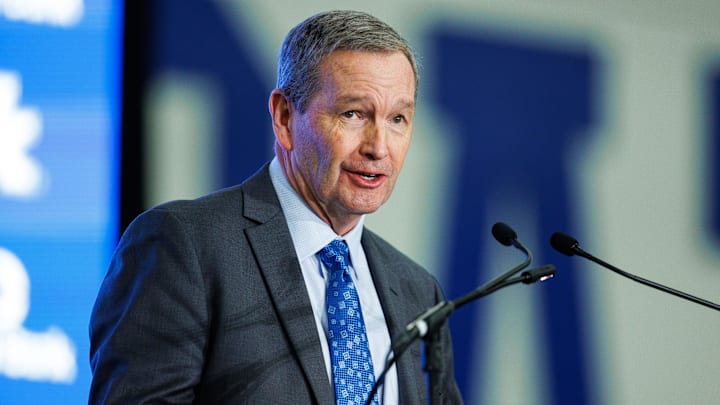
Mitch Barnhart will leave Lexington with a complex and lasting legacy that spans nearly three decades. Hired in 2002 to succeed Larry Ivy, he arrived as a reformer from Oregon State and transformed Kentucky into a broad-based powerhouse that consistently ranks in the Top 20 of the NACDA Directors' Cup.
The "Olympic" blueprint
If you measure success by the sheer number of trophies and world-class athletes, Barnhart’s tenure is unprecedented. He oversaw six national championships, including the 2012 men’s basketball title, the 2020 volleyball title, and four rifle titles, and saw the department grow from a regional player into a global entity in most every sport.
Under his watch, Track and Field produced legends like Sydney McLaughlin-Levrone, and the baseball program finally reached its first-ever College World Series in 2024. The facilities he raised money for and helped build, from the $130 million football stadium renovation to the pristine Kentucky Proud Park, are among the best in the country.
The Kentucky basketball and football "rough patches"
However, the "legacy" conversation in Kentucky is always filtered through the high-revenue sports. Despite the 2012 title, the men’s basketball program has now gone six years without an SEC title and nearly a decade since cutting down the nets at the SEC Tournament. That should never happen here in Lexington.
Many fans point to Barnhart's "old school" approach to NIL and the controversial $465 million JMI partnership (recently extended through 2040) as primary hurdles. The belief is that the highly structured JMI deal has made Kentucky less "nimble" in the NIL bidding wars required to land elite 2026 talent.
This is despite Mark Pope saying that other coaches and ADs have been calling to duplicate the setup at Kentucky. The result of 0 commits in 2026 has fans convinced it is JMI.
From Olympic gold to the $10,000 season ticket
There is a cost to excellence; you can't be great without paying for it one way or another. While Barnhart brought in millions for upgrades, it often came at the cost of the regular fan. The rise of K-Fund donations has made lower-arena Rupp seating, ranging from $2,600 to $10,000 per seat with donations included, feel more like an NBA experience than a traditional college one. The push for luxury boxes and the new "Entertainment District" has been hailed as a revenue masterstroke by some and a betrayal of the average fan by others.
You look at how much money the Atlanta Braves Battery district generated for the club, over 660 million in 2024, and you see why he wants to do it. There would be money flowing year-round to restaurants, shops, and more. No longer would it be empty when a game is not happening. But again, it comes at the cost of parking and easy access for fans.
A man of principles
Barnhart was often a man out of time in a world that was rapidly changing. He resisted alcohol sales at Kroger Field for years, prioritizing a "family-friendly" atmosphere until the economic pressure became undeniable. He struggled with the move toward a "professionalized" college model, often speaking of his desire to keep academics at the heart of the mission.
Remember when Cardale Jones told everybody he didn't go to Ohio State to play school? Well, Mitch Barnhart was the exact opposite.
His coaching hires remain his most debated decisions. From the gamble on Billy Gillispie to the "lifetime" contracts awarded to John Calipari and Mark Stoops, Barnhart’s loyalty often became a double-edged sword. Yet, his final major hire, Will Stein for football and Kenny Brooks for the women’s program, appear to be the "new era" moves fans were clamoring for.
How it goes long term with Mark Pope probably has as much of an impact on his legacy as any hire though.
Where does Kentucky go next?
Mitch Barnhart didn't just run an athletics department; he built an empire of steel, glass, and gold medals. Kentucky athletics is a fundamentally different beast than the one he found in 2002. As he transitions to retirement, he leaves behind a landscape that is both more successful and more expensive than ever before.
That begs the question of where the University of Kentucky turns to next. I have a pretty good idea of that, and you will too by clicking here and reading the top 3 names you need to watch.
 Add us as a preferred source on Google