

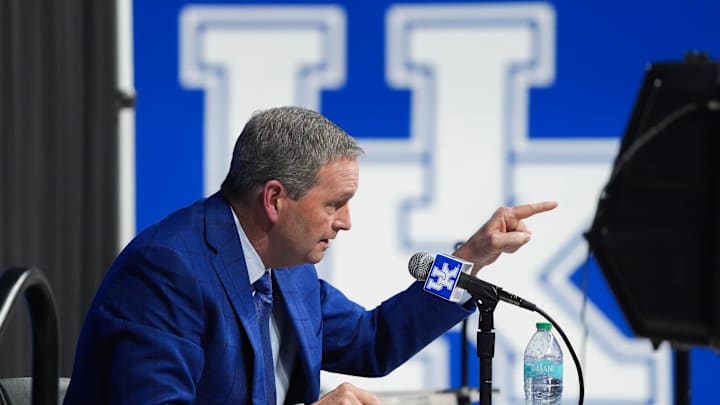
Kentucky Athletics just made a massive splash in the merchandising world, announcing a first-of-its-kind, 12-year partnership extension with sports entertainment company Fanatics.
Anchored by a significant investment dedicated exclusively to NIL opportunities, the deal is designed to channel BBN's passion and willingness to support the university into cash going into athletes' pockets.
The length of the contracts Kentucky is currently signing is absolutely insane, and someone needs to tell them to stop, though, 12 years?
On the surface, there is a lot to love about this announcement if you are a Kentucky fan. The money is undeniably good for the players, though Fanatics can be a little pricey with their licensed stuff.
Fanatics promised to work with select UK student-athletes through their Creator Program, allowing players to launch their own affiliate storefronts. They can sell and curate product collections that they want to create and sell. Seamlessly linking merchandise to their social media accounts gives them the ability to sell directly to the fans. Add in the trading card opportunities through Topps and BowmanU, and it is clear that this deal provides incredible, real-world revenue avenues for the players.
But things are bound to change in NIL, and Kentucky is now linked with JMI for 15 years and Fanatics for 12. Is it really that good of a thing?
The danger of locking into massive, long-term deals
Think about where the landscape of college athletics was just three short years ago. Now, try to imagine where it is going to be three years from now. And then 10 years from there.
We are currently watching the entire foundation of the NCAA shift in real-time, almost monthly. We are staring down the barrel of direct revenue sharing, federal executive orders regarding pay-for-play, and the complete restructuring of conference realignments. The Pac-12 is relaunching, and we have teams travelling from coast to coast to play a single game weekly
Yet, for some reason, Kentucky is actively choosing to tie itself up in these massive, long-term agreements.
First, the university signed a staggering 15-year multimedia rights deal with JMI Sports. Now, they are locking into a 12-year extension with Fanatics. Why on earth are university administrators signing decade-plus contracts when the entire financial model of college sports could be completely unrecognizable by 2029?
But we know what Kentucky's will look like thanks to these long-term deals. And let me say, the short-term cash is great; there are probably some good things that will come of that. But the future is a huge question mark.
Handicapping the future of Champions Blue, LLC
What makes this even more puzzling is that the UK Athletics Department is currently in the process of shifting its operations over to Champions Blue, LLC.
According to the university, this non-profit holding company is a "first of its kind in college athletics, designed to provide the department with the flexibility to unlock new revenue streams through public-private partnerships."
Flexibility is the exact keyword there. If the entire goal of restructuring the athletic department into a private LLC is to remain nimble and adapt to the new age of college sports, why are you immediately handcuffing that new entity with 12 and 15-year merchandise and media deals?
If the market absolutely explodes in five years and the value of these rights doubles, Kentucky can try to renegotiate, but why would JMI or Fanatics do so? They could simply say, no we have another 10 years to go before we even think about it.
If the federal government mandates a completely new revenue-sharing model that conflicts with the structure of this Fanatics deal, navigating it will be a legal nightmare.
Having guaranteed money and taking care of the current student-athletes is a great thing today. I understand where the idea is coming from. But in a sport where the rules change every single offseason, signing a 12-year contract is a massive gamble that quite frankly didn't need to happen. It could have been a simple 5-year deal.
But for better or worse, Kentucky is officially locked in.
 Add us as a preferred source on Google