

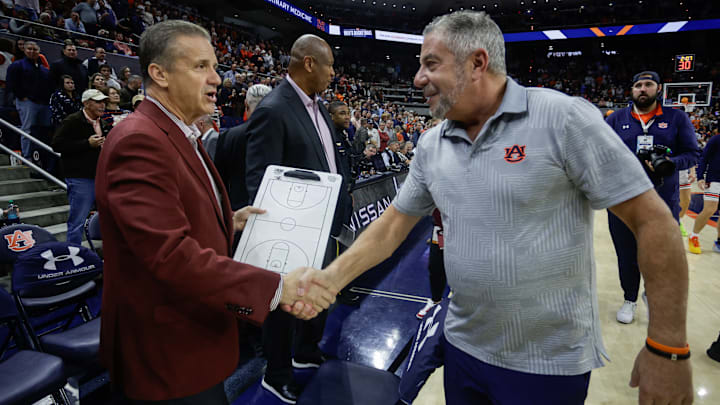
John Calipari and Bruce Pearl aren’t supposed to be on the same side of anything.
They’re different brands of loud. Different brands of confident. One is a slick-talking program builder who can turn a press conference into the Gettysburg Address. The other is a human energy drink who might sprint into the student section if you give him a reason. They’ve competed, sniped, rolled their eyes at each other, and generally represented two completely different philosophies on how to live inside college basketball.
So when both of them are staring at the same horizon and saying, in their own ways, “this isn’t going to last,” it’s worth treating that as more than offseason noise.
John Calipari’s point isn’t about control, it’s about consequences
Calipari’s solution is predictable, but the reasoning underneath it is what matters. He’s been pushing a model that essentially gives players one free transfer, then attaches restrictions after that. In his view, you can’t build a real academic track, or real stability, if an athlete is bouncing constantly.
Few 18-year-olds would turn down a massive NIL check and a free education. However, as usual, Coach Calipari @CoachCalArk offers an educated perspective on the realities of the game and preparing for life after it's all over... pic.twitter.com/RknuaHvgku
— NIL 𝘯𝘰𝘵 NLI (@NILnotNLI) December 28, 2025
What Cal does better than most coaches is speak in human outcomes rather than administrative jargon. His fear isn’t that coaches are losing leverage. His fear is that players are being set up to fail after the applause ends, which for a lot of them is after they play their last game in college.
He’s painting a picture of a player who transfers repeatedly, never truly settles academically, and eventually runs out of eligibility without a meaningful degree. Because a guy who transfers 4 times has no shot at graduating, and the last school he was at isn't going to treat him like he had been there for 3 or 4 years.
Then the athlete hits the workforce, gets offered a job for "$55,000" and wonders if he "has to show up." That amount is not a low ball offer, the Bureau of Labor Statistics suggests that someone with some college/Associate Degree earns around $43,000 - $55,000+ as a starting point. But these guys are making hundreds of thousands in NIL, and his lifestyle is now going to be halved or more, and he realizes adulthood isn’t sponsored. He said he is worried about the "mental health," and he is right.
Cal doesn’t have to be your favorite person to have a real point here: a system that normalizes constant movement also normalizes incomplete development: on the court, in the classroom, and emotionally.
Bruce Pearl’s framing is the one administrators don’t want to say out loud
Pearl, meanwhile, has gone where most coaches avoid going publicly: he’s essentially pointing toward collective bargaining as the only realistic path to long-term stability.
At this point we have two options to save intercollegiate athletics. Congress gives the NCAA anti trust protections to make the old system work which is unfair to student athletes OR we have collective bargaining. The longer we wait, the more it costs everyone @A1Policy https://t.co/i69xIf17im
— Bruce Pearl (@coachbrucepearl) December 28, 2025
Even if you ignore the exact phrasing of his social media post, the underlying argument is straightforward: if college sports is going to behave like a labor market, it eventually has to be governed like one. That is just common sense.
And that matters because it exposes the real fork in the road:
Option 1: Try to “save” the NCAA model with legal protections.
That usually means some form of congressional action that shields the NCAA (or a new governing body) from antitrust challenges long enough to impose uniform rules again. This would eventually involve transfer restrictions, NIL guardrails and real enforcement teeth. Not the haphazard lawsuit-scared NCAA.
Option 2: Admit athletes are labor in a revenue sport and negotiate accordingly.
That means contracts. Representation. Rules created at the bargaining table. A structure that looks less like amateur athletics and more like an organized sports enterprise. Because that is what is happening right now anyway. Amatuer athletics is at a very dangerous point.
Pearl’s premise is uncomfortable, but it’s coherent: the longer the sport delays a real framework, the more chaotic, and expensive, the chaos becomes.
What collective bargaining would actually change
Collective bargaining isn’t a buzzword. It’s a process that will really change fundamentally the entire framework of the NCAA.
If athletes collectively bargain, you open the door to:
- Standardized agreements that define compensation, benefits, and obligations.
- Rules around movement that look more like contract terms than wishful thinking.
- Robust revenue-sharing systems that replace booster improvisation totally, not just supplment it
- More consistent enforcement because violations become labor disputes, not PR fires.
That structure would also force honesty. Right now, everyone pretends this is still an amateur model with a few exceptions. Collective bargaining would end the pretending.
But it also isn’t simple, and that’s why we’re still here.
The hurdles are real, and they’re why the “Wild West” keeps winning
There are enormous complications:
- Public vs. private universities don’t operate under identical labor frameworks.
- Who is the employer—the school, the conference, a collective entity?
- What does a players’ “union” look like across hundreds of programs?
- How do you separate football/basketball from every other sport without detonating budgets and Title IX debates?
Those questions are precisely why athletic departments are anxious. Not because they don’t want athletes paid, money is already flowing freely. They’re anxious because rules require accountability, and accountability is the one thing this era doesn’t have right now.
Why this matters even if you hate both guys
Here’s the punchline: Calipari and Pearl aren’t offering the same solution, but they are diagnosing the same disease.
Cal is trying to restore guardrails inside the current model. Pearl is implying the model itself is beyond patching.
When two coaches with different motivations, different histories, and different public personas reach the same conclusion, “this won’t survive as-is,” that’s not doom-posting. That’s an industry signal.
And college athletics has been flashing that signal for a while.
 Add us as a preferred source on Google