

When Kentucky football reportedly turned its defense over to Jay Bateman, the first reaction was about recruiting. His history with blue-chip defenders and his connections in places like the Carolinas, Florida and Texas are exactly what Will Stein wants in a staff built to win in the portal and NIL era. That part is easy to get excited about.
The harder, more complicated question is this: what does the on-field track record actually look like when Bateman is the one calling the shots?
What Jay Bateman’s track record really tells Kentucky football
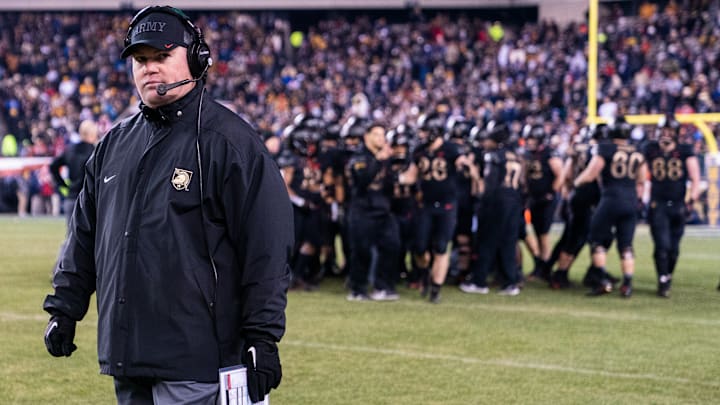
The cleanest place to start is at Army, where his reputation was really made. Before he arrived, the Black Knights were just another service academy trying to hang on defensively. During his run as defensive coordinator from 2014 through 2018, the numbers steadily moved from “scrappy” to “legitimately nasty.” Scoring defense dropped into the mid-teens, total yardage allowed sank under 300 yards per game, and opponents struggled to string together explosive plays. By 2018, Army ranked among the top units nationally in scoring and total defense, a huge reason the Black Knights went 11–2 and nearly upset Oklahoma in Norman.
Those years showed the best version of Bateman’s philosophy. He built a scheme that blended disguise, simulated pressures and aggressive early-down calls to create chaos without taking wild, undisciplined risks. Army did not have SEC bodies, but it consistently punched above its weight by being in the right place and forcing quarterbacks into bad decisions. That work earned Bateman national attention and a Broyles Award finalist nod in 2018, putting him on the radar for Power Four jobs.
At North Carolina, the story is more of a mixed bag. Bateman arrived with momentum, but the ACC is not the same as life at a service academy. Over three seasons in Chapel Hill, UNC’s defense had flashes of real quality but never fully stabilized. By 2021, the Tar Heels had slid to 105th nationally in scoring defense at 32.1 points allowed per game and 94th in total defense at 418 yards per game. A miserable Mayo Bowl loss to South Carolina, where UNC gave up 38 points and 543 yards, became the breaking point, and Bateman was let go after the season.
That context matters for Kentucky fans because it shows the downside risk. When personnel doesn’t quite match the scheme, or when tackling and communication are not up to standard, Bateman’s defenses can give up big plays in bunches. The same aggression that creates havoc at their best can turn into gashed coverages and chunk runs at their worst.
After a stint as Florida’s inside linebackers coach, Bateman landed at Texas A&M as defensive coordinator and linebackers coach in 2024. The first year was rocky enough that he finished under scrutiny, with the Aggies struggling in key moments and head coach Mike Elko plainly unhappy about the unit’s collapse in a bowl loss to USC. Elko, a defensive specialist himself, took over the playcalling load in 2025, and the defense improved, climbing into the top-20 nationally in total yardage allowed and tightening up in the red zone.
It is fair to say Bateman’s time in College Station ended on a more positive note than it began, even if he was no longer the primary voice on game day. That duality is important when you project him to Kentucky. On one hand, he has shown he can design and coach top-tier defenses when the pieces fit and when the culture is aligned around physical, detailed play. On the other, the UNC experience and the early Texas A&M wobble are reminders that simply hiring a big name recruiter does not guarantee instant results.
So what is Kentucky really getting?
First, an identity. Bateman is not a bend-but-don’t-break coordinator. His defenses are at their best when they are throwing different looks at quarterbacks, firing simulated pressures, stemming fronts late and forcing mistakes. In an SEC that is more wide-open than ever, you would rather live with an attacking mindset than sit back and die slowly.
Second, a coach who understands how modern offenses operate. By now, Bateman has seen just about everything: triple-option service-academy attacks, tempo spread systems, RPO-heavy schemes, pro-style SEC builds. That experience matters for a first-time head coach like Stein, who needs a partner on defense who will not be surprised by anything on the schedule.
Third, and maybe most crucially, a coordinator who knows this is probably his last, best chance to prove he can run a high-major defense at a high level. After UNC and the up-and-down Texas A&M stint, Bateman arrives in Lexington with as much to prove as Kentucky does.
For Big Blue Nation, the realistic expectation should fall somewhere between the Army peak and the UNC low. If Stein and his staff can recruit to Bateman’s vision and give him enough twitch on the edge and speed on the back end, Kentucky has a real shot to build an aggressive, turnover-hungry defense that fits the style of ball the Wildcats want to play. If they miss in talent acquisition or the communication piece lags, the roller coaster could tilt toward the wrong side.
Either way, Kentucky is not playing it safe. This hire is a swing for a coordinator with clear strengths, real scars and a track record that guarantees one thing: boring is not on the menu in Lexington.
 Add us as a preferred source on Google