

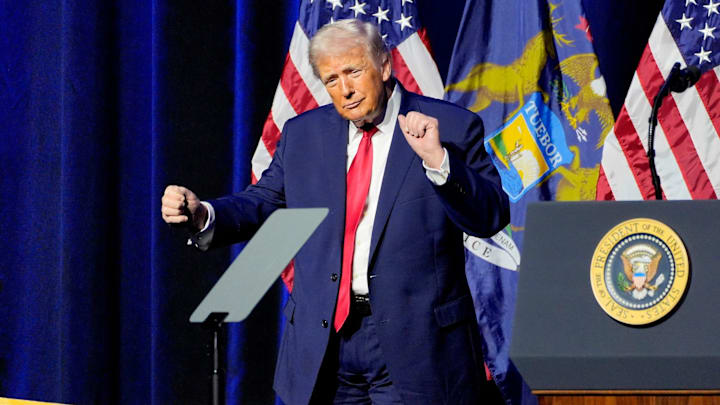
Not only did Donald Trump make a commission to save college sports, but the President also just signed an executive order that will change college athletics. And if it is enforced, Mark Pope will greatly benefit.
The biggest change is that each player can transfer just once during their undergraduate career without sitting out. It would incentivize players to stay at one program for multiple years, and Mark Pope is known as a coach who really knows how to develop players. Plus, it would mean less recruiting, and with Mark Pope's struggles there, it could help the coach get and keep the players he wants.
But will it actually hold up and what is changing?
What's changing?
The mandated rule changes (What the NCAA must do)
- The 5-Year Clock: Players get a strict, hard-capped five-year window to play the sports they are interested in, you get a redshirt year, and that's it.
- Transfer Guardrails: The Transfer Portal will be less active because guys can no longer transfer every single year with no penalty. One free undergraduate transfer, and then you have to sit out. It is being marketed as a way to ensure students are actually able to earn degrees and not just NIL money.
- Guaranteed Healthcare: Schools must provide proper, guaranteed medical care for all student-athletes. That is a huge win for a lot of athletes at smaller programs.
- Revenue Sharing with a Catch: Schools will implement a system to share revenue with the athletes, but they absolutely must do it in a way that protects the funding and future of women’s and Olympic sports. No more loading up on basketball and football and letting everything else go; Kentucky already does this one.
- Killing "Pay-for-Play": NIL collectives and boosters are officially banned from handing out straight-up cash agreements just to buy a player's commitment to a school. This is my biggest win of the entire thing; I loathe collectives. It makes no sense to just allow guys to be paid to commit to a school.
- Regulating Agents: New rules will be put in place to protect college kids from being taken advantage of by shady sports agents. No more predatory agreements and bad guidance.
Under Mitch Barnhart, Kentucky has really built a program that spreads the money around. Women's basketball, baseball, softball, track and field, and soccer have all greatly benefited from new or updated stadiums and improved funding. This type of rule change would level the playing field across the board and make schools invest in sports that do not always return a large amount of money.
Having a kid come in knowing they have 5 years, and they can only transfer once without sitting out, would allow a coach like Mark Pope to really develop kids in his system. That kind of patience and practice would help players get familiar with his complex offense and run it with precision.
How do they plan on actually enforcing it?
The enforcers (Who is doing what)
- The Watchdogs: The Department of Education and the General Services Administration are going to act as the scouts. They will gather all the data from schools, track the money exchanging hands, and report the schools that are cheating or skirting the rules.
- The Muscle: The Attorney General (AG) and the Federal Trade Commission (FTC) are the actual enforcers who will step in, drop the hammer, and punish the programs that break the rules.
What is the hammer though?
The ultimate threat (The hammer)
- Lose the Rules, Lose the Money: If a university breaks the rules regarding the transfer portal, player eligibility, or illegal "pay-for-play" schemes, the federal government can completely strip them of their federal grants and funding contracts.
That is how this whole thing is going to actually force schools to comply. The NCAA has been doing this for years, but no one is afraid of the NCAA. They just keep on doing what they're doing, but this has real consequences that could really enforce changes that would return some normalcy to college athletics.
The only issue is that it is highly unlikely to hold up in court; the President is basically taking the position of the NCAA, and they keep losing in court because of Antitrust conflicts. This will be challenged very early on.
In the end, reform is needed. I don't know the right answer, but maybe this pushes Congress to act before college sports just become a minor league for the pros, where kids don't come to "play school."
 Add us as a preferred source on Google