

The NIL era has essentially rendered college basketball teams as unregulated money-printing machines. The sheer volume of cash changing hands is starting to break the fundamental structure of the sport. The soul of the game is being changed irreversibly before our eyes.
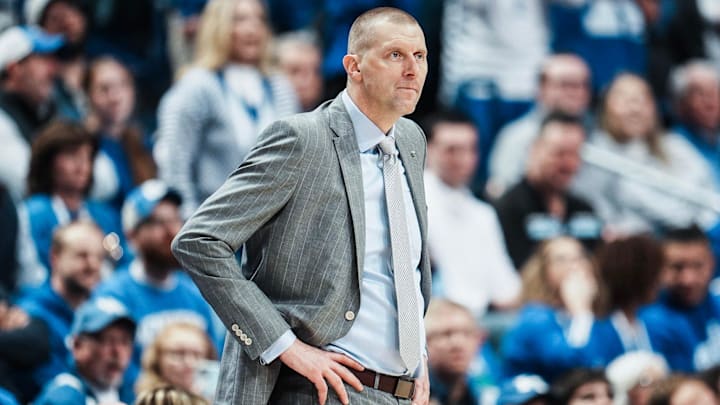
A year after Kentucky basketball reportedly spent north of $20 million to construct its roster, Texas head coach Sean Miller shed some light on just how normalized that astronomical figure has become. In a recent interview on The Field of 68, Miller estimated that the number of programs dropping that kind of cash is skyrocketing.
“Educated guess? Sometimes you don’t have all the information, how many with $20 [million]? I would say 20-25.” That number is staggering and, for Kentucky specifically, it represents a harsh new reality.
A Harsh New Reality
No longer can a program throw the biggest bag of money at the wall and expect a five-star player to commit. If you need proof of that, take one look at the Tyran Stokes recruitment. Kentucky is a Nike school, and Stokes is a signed Nike athlete; yet, he chose an Adidas program, in Kansas.
The financial playing field at the top is now leveling out. Players can get life-changing money almost anywhere now - cash is just the cover charge to get into the room. It wasn't supposed to be this way.

Now, these athletes should certainly be getting paid. They generate billions of dollars in revenue on a yearly basis and, prior to the NIL era, couldn't get so much as a stipend. But it isn't brand deals and local sign-ons paying players; coaches get in bidding wars just to get a guy to play for them.
It's less about paying players their dues and more about burning money for their allegiances.
The Nonexistent Cap
Under the new revenue-sharing rule birthed by the House v. NCAA settlement, programs have a spending cap of roughly $20.5 million, with incremental increases set for future years. So, if basketball alone is eating up $20 million, where is the rest of the money coming from?
The answer? Third-party collectives and padded booster bank accounts, it seems. Jeff Goodman reported that an anonymous high-major head coach earlier told him the cap means nothing: “The cap is irrelevant to us. With the way we are operating, there’s no cap at all.”
If that isn't a sign that things have flown off the rails, I'm not sure what could be.
We are already seeing the devastating trickle-down effect of this principle: Arkansas is completely shedding its men's and women's tennis programs. They likely won't be the only ones. From a cold, capitalistic point of view, it makes sense. Make money, or go out of business. But this is supposed to be college sports, not Wall Street.
The traditional collegiate pathway is rapidly narrowing. Education has taken a backseat to legacy, and life-changing opportunities at school, hedged with a potential career in athletics, are going away. The NCAA sits on the sidelines throughout it all, paralyzed by an endless string of lost lawsuits.
Trading Memorials for Money
Mark Pope made a desperate plea to stop this insanity last season, but the machine is only getting bigger. The race is bleeding into what was thought to be sacred places, too, as Kentucky is actively looking to commercialize Historic Memorial Coliseum in the financial arms race.
That boils down to selling the naming rights to a war memorial, a building dedicated to Kentuckians who gave their lives in combat, to keep up with Texas and Ohio State in a recruiting battle.
At some point, we have to take a real look around and simply ask ourselves: "What are we doing?"
 Add us as a preferred source on Google